LSAT vs. GRE: The 2026 Law School Admissions Comparison
Should you take the GRE or the LSAT for law school in 2026? Now that Logic Games are gone, the choice is more complex. Compare acceptance rates, scholarship impact, and subject matter in LawZee's definitive guide.
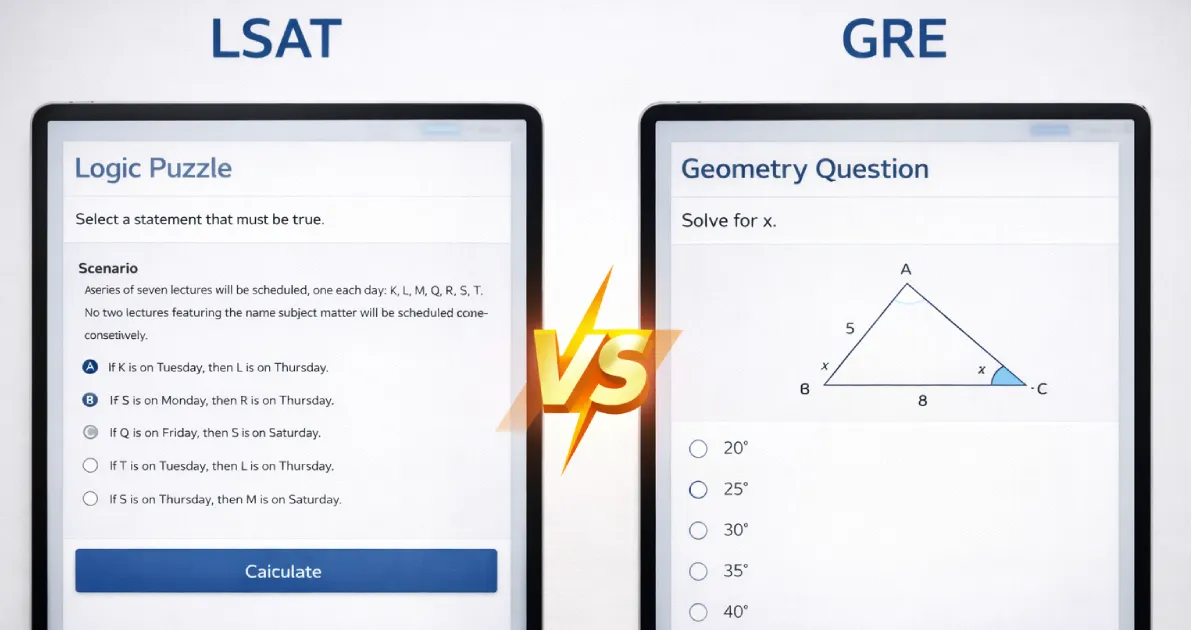
LSAT vs. GRE: The 2026 Law School Admissions Comparison
In 2026, over 100 law schools accept the GRE, including nearly all of the T14. But acceptance doesn't mean equivalence. The removal of Logic Games has made the LSAT a "reading and logic" marathon, narrowing the gap between the tests—but rankings still favor the LSAT. This guide cuts through the marketing to help you choose the test that maximizes your admissions potential.
Brutally Honest: Rankings Bias
Law schools are ranked by U.S. News & World Report based on their median LSAT scores. While schools accept the GRE, an LSAT score is "worth more" to their rankings. This is why even schools that accept both tests often weigh LSAT scores more heavily in admissions decisions.
The Insider Reality
A 170 LSAT might be worth $50,000+ more in scholarship than a 170 GRE equivalent. Rankings drive funding, and funding drives merit aid budgets.
The Content Comparison: Head-to-Head
2 Logical Reasoning sections: Argument analysis and formal logic.
1 Reading Comprehension section: Comparative passages and inference questions.
1 Argumentative Writing: Unscored essay submitted to schools.
Verbal Reasoning: Vocabulary, reading comp, analogies.
Quantitative Reasoning: Algebra, geometry, data analysis.
Analytical Writing: Issue and argument essays.
The 2026 Pivot
Percentile Comparison: What Scores Really Mean
*Note: These are approximate equivalents. Use the ETS conversion tool for precision.
Who Should Take the GRE?
STEM applicants: If your GRE Quant score is 165+, it validates your quantitative abilities and can be a differentiator.
Dual-degree candidates: If you're applying to MBA/PhD programs, one GRE score serves multiple applications.
Math-heavy transcripts: If your GPA is driven by engineering/math courses, the GRE reinforces that narrative.
GRE Success Story
"As a former engineer with a 170 Quant GRE, I turned down Harvard Law because they offered me $50k less than a school that valued my math background. Rankings matter, but so does your unique profile."
Who Should Take the LSAT? (The Default Choice)
T14 targets: LSAT scores are the primary driver of U.S. News rankings. Better chance at merit aid.
Humanities majors: No math requirement. Pure verbal/logic test that matches your transcript.
155+ diagnostic scorers: If your practice LSAT is already competitive, don't risk switching tests.
LSAT Strategy
"The LSAT is designed for law school. It tests the exact skills you'll use in 1L: close reading, logical analysis, and argumentation. The GRE is a general graduate test that happens to be accepted."
Quiz: Which Test is Right for You?
The "One-Test" Rule
Critical Warning
If you take the LSAT, law schools must report that score to the ABA for their median calculations—even if you submit a GRE score instead. You cannot "hide" a bad LSAT score with a good GRE score. The ABA requires full disclosure.
Strategy: Only take the LSAT if you're confident in your score. If you suspect you'll do poorly, stick with the GRE and target schools where LSAT isn't mandatory.
Decision Matrix: LSAT vs. GRE
| Aspect | LSAT | GRE |
|---|---|---|
| Time | 35 min sections, 3 hours total | 30-35 min sections, 3 hours 45 min total |
| Cost | $230 | $205 (U.S. / Canada) |
| Subject Matter | Logic, Reading, Writing | Verbal, Math, Writing |
| Admissions Weight | Primary for T14 rankings | Accepted but secondary |
Still Not Sure? Compare Your Scores
Use the official ETS GRE-to-LSAT conversion tool to see how your scores stack up.
Frequently Asked Questions
Do I get more scholarship money with the LSAT?
Generally, yes. Schools use LSAT scores for U.S. News rankings, so high LSAT scores are more valuable to their prestige and merit aid budgets. A 170 LSAT might yield $50,000+ more in scholarships than a 170 GRE equivalent.
Is the GRE easier than the LSAT?
Not necessarily. The GRE requires math, which can be a barrier for non-STEM applicants. The LSAT is purely verbal/logic, but its questions are often more complex and time-pressured. Take diagnostics for both.
How do schools compare the scores?
Most use the ETS conversion tool to map GRE scores to LSAT equivalents. However, admissions committees read the raw scores and consider your overall profile. A 165 GRE Verbal isn't exactly a 165 LSAT.
If I already have a GRE score for another master's, should I still take the LSAT?
It depends on your GRE score and target schools. If your GRE is elite (162V+) and you're applying to non-T14 schools, you might not need the LSAT. But for T14 schools, the LSAT is still preferred.
— Dual-Test Admissions Consultant
![[ARCHIVED] LSAT Logic Games Guide (Legacy)](/lsat-logic-games.png)