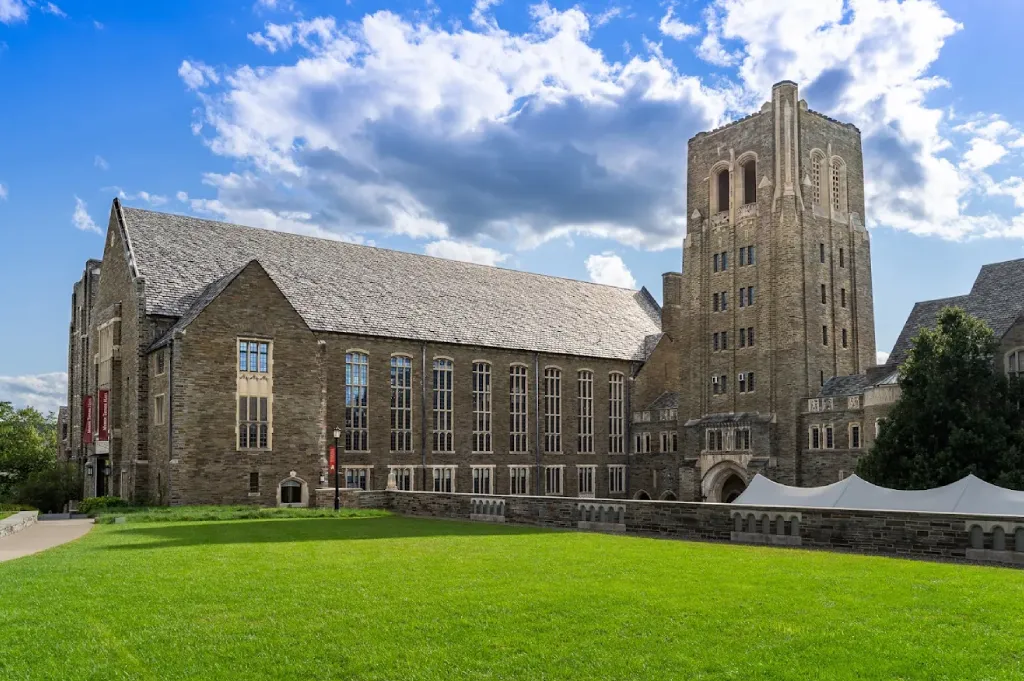
Cornell Law School
Lawzee EliteOverview
Cornell Law School, located in the picturesque college town of Ithaca, New York, is a member of the Ivy League and the prestigious 'T14.' It is distinctive for having one of the smallest class sizes (approx. 200 students) among elite law schools. This creates a remarkably close-knit community where students and faculty interact daily. Despite its rural location, Cornell acts as a direct teleporter to Wall Street; it consistently ranks #1 or #2 in the nation for placing graduates into large law firms, punching well above its weight class.
Academic Environment
Cornell is defined by rigorous intellectualism in an intimate setting. With an exceptionally low student-to-faculty ratio, students cannot hide in the back of the lecture hall—engagement is mandatory. Cornell is famous for its strength in International Law. The Berger International Legal Studies Program allows students to earn dual degrees with partner universities in Paris, Berlin, and Beijing. The workload is known to be demanding ('The Cornell Grind' is a real reputation), but the small community fosters deep camaraderie rather than cutthroat competition. Students live, study, and socialize together in a way that urban commuter schools cannot match.
Career Outcomes
Cornell is a 'BigLaw' Juggernaut. Year after year, it places a staggering percentage (often 70-80%) of its class into the nation's largest law firms. It is the dominant recruiting ground for New York City firms, who view Cornell grads as 'practice-ready' and exceptionally hard-working. While the majority head to Manhattan, the school also has strong pipelines to D.C. and Boston. If your goal is to work at a Vault 10 firm, Cornell offers arguably the highest statistical probability of success per capita of any law school.
Insider Perspective
Cornell Law School is intense, close-knit, and phenomenally successful at placement. Located in Ithaca, it is geographically isolated, which creates a 'pressure cooker' environment where students bond deeply because there are no distractions. The winter is long and harsh, but that just means more time in the library, which is arguably the most beautiful in the country. The result is a student body that works incredibly hard. BigLaw firms in NYC know this—they view Cornell grads as battle-tested and ready for the brutal hours of corporate law. Admissions advice: Cornell is one of the few schools that still does admission interviews via a pre-recorded video platform (Kira Talent), so practice your 'on-camera' presence. They also care about 'Why Cornell?' beyond just the ranking—mentioning specific clinics or the small class size helps. If you can handle the cold and the workload, Cornell is statistically the surest bet in the country for landing a six-figure job at a top Manhattan firm.
Areas of Study
Top Clinics
Journals
LSAT Score Distribution
A median LSAT of 172 places Cornell Law among the most competitive law schools. Applicants below 169 should consider retaking the exam or emphasizing other strong application components.
Undergraduate GPA Distribution
Application Components
- ✓Personal Statement
- ✓CAS Report (LSAT & Transcripts)
- ✓2-3 Letters of Recommendation
- ✓Resume
- ?Diversity Statement (Optional)
- ?Interview (By Invitation)
Frequently Asked Questions about Cornell Law
Is it hard to get into Cornell Law School?
Yes, Cornell Law is extremely competitive with an acceptance rate of 19.2%. Successful applicants typically have LSAT scores above 169 and GPAs above 3.79.
What is the lowest LSAT accepted?
While there is no strict minimum, the 25th percentile LSAT score is 169. Applicants scoring below this number face significant challenges but may be considered if they have exceptionally strong soft factors or work experience.
Does Cornell Law require an interview?
Interview policies vary by year, but top-tier schools like Cornell Law often use interviews (by invitation) to evaluate candidates holistically. Check the specific requirements in the Admissions section above.
What is the employment rate for graduates?
98.9% of graduates are employed 10 months after graduation. A significant portion (64%) go into BigLaw firms, while 12.6% secure federal clerkships.