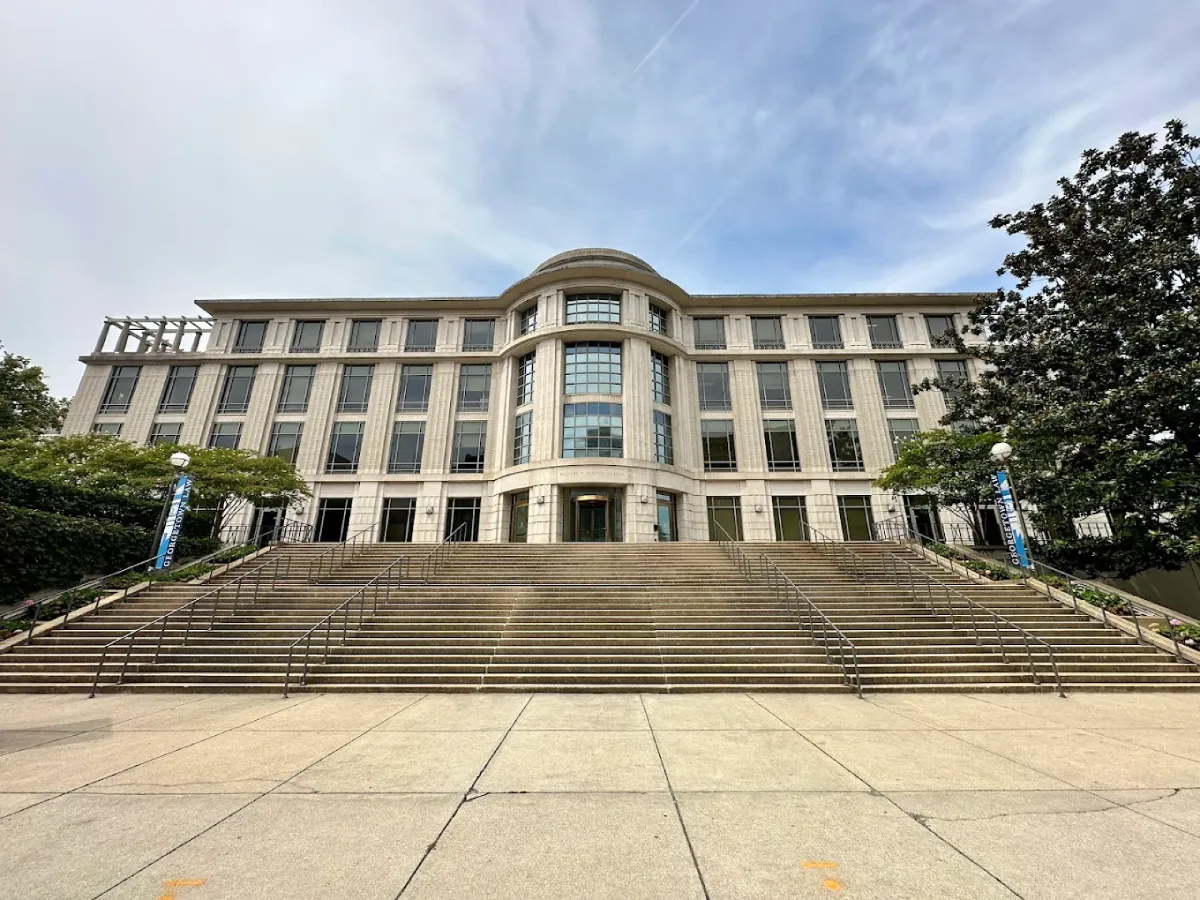
Georgetown University Law Center
Lawzee EliteOverview
Georgetown Law is the law school of Georgetown University and the largest law school in the United States by enrollment. Located in Washington, D.C., it sits less than a mile from the U.S. Capitol and Supreme Court, allowing students to study the law where it is written, interpreted, and enforced. As a perennial T14 school, Georgetown combines national prestige with deep strength in public law, international law, and practice-oriented legal education.
Academic Environment
Georgetown offers both full-time and part-time (evening) J.D. programs and the most extensive course catalog in the country, with hundreds of classes each year and more than a dozen student-run journals. Its clinical and experiential programs are a signature strength: the school is ranked #1 nationally in Clinical Training and operates a sprawling set of in-house clinics, externships, and simulation courses that plug students directly into federal agencies, Capitol Hill, and D.C. nonprofits. The campus is urban and self-contained, anchored by McDonough Hall, the Edward Bennett Williams Law Library, the Hotung International Law Center, the Gewirz Student Center, and the Ginsburg Sport & Fitness Center.
Career Outcomes
Georgetown places graduates into every major sector of the legal market, but especially into large law firms and public service. Recent data show that well over 95% of graduates are employed within 10 months of graduation, with roughly three-fifths entering national law firms (BigLaw-type positions) and a significant share in government, public interest, and international organizations. The school’s bar passage rate is in the low-90s and above the weighted state averages, and its enormous alumni network in D.C., New York, and other major markets creates strong pipelines into BigLaw, federal clerkships, and high-level government roles.
Insider Perspective
Georgetown Law is all about location and scale. Situated at the foot of Capitol Hill, it offers access to the machinery of government that no other school can match. Adjunct professors here aren't just practicing lawyers; they are often the people writing the regulations or arguing the cases before the Supreme Court. The sheer size of the student body (it is the largest T14) means the course catalog is endless—if you want to take a seminar on 'Space Law' or 'Cyber-Espionage,' it's probably offered here. This size allows for niche communities to form, but it also means you have to be proactive to find your tribe. The 'Curriculum B' (Section 3) option for 1Ls covers the same material as traditional courses but through a critical, philosophical lens, and is a unique intellectual experience. Admissions advice: Georgetown values 'Why Georgetown' specific essays heavily and often waitlists high-stats candidates who don't show genuine interest. They are also one of the few top schools with a robust part-time evening program, which is a legitimate backdoor for working professionals to get a T14 degree without quitting their jobs.
Areas of Study
Top Clinics
Journals
LSAT Score Distribution
A median LSAT of 171 places Georgetown Law among the most competitive law schools. Applicants below 166 should consider retaking the exam or emphasizing other strong application components.
Undergraduate GPA Distribution
Application Components
- ✓Personal Statement
- ✓CAS Report (LSAT & Transcripts)
- ✓2-3 Letters of Recommendation
- ✓Resume
- ?Diversity Statement (Optional)
- ?Interview (By Invitation)
Frequently Asked Questions about Georgetown Law
Is it hard to get into Georgetown University Law Center?
Georgetown University Law Center is moderately competitive with an acceptance rate of 20.1%. Applicants with scores near the median of 171 LSAT and 3.92 GPA have a strong chance of admission.
What is the lowest LSAT accepted?
While there is no strict minimum, the 25th percentile LSAT score is 166. Applicants scoring below this number face significant challenges but may be considered if they have exceptionally strong soft factors or work experience.
Does Georgetown Law require an interview?
Interview policies vary by year, but top-tier schools like Georgetown Law often use interviews (by invitation) to evaluate candidates holistically. Check the specific requirements in the Admissions section above.
What is the employment rate for graduates?
95.1% of graduates are employed 10 months after graduation. A significant portion (58.2%) go into BigLaw firms, while 4.8% secure federal clerkships.