
Browse Law Schools by State

Law Schools in AlabamaLaw Schools in AlaskaLaw Schools in ArizonaLaw Schools in ArkansasLaw Schools in CaliforniaLaw Schools in ColoradoLaw Schools in ConnecticutLaw Schools in DelawareLaw Schools in DCLaw Schools in FloridaLaw Schools in GeorgiaLaw Schools in HawaiiLaw Schools in IdahoLaw Schools in IllinoisLaw Schools in IndianaLaw Schools in IowaLaw Schools in KansasLaw Schools in KentuckyLaw Schools in LouisianaLaw Schools in MaineLaw Schools in MarylandLaw Schools in MassachusettsLaw Schools in MichiganLaw Schools in MinnesotaLaw Schools in MississippiLaw Schools in MissouriLaw Schools in MontanaLaw Schools in NebraskaLaw Schools in NevadaLaw Schools in New HampshireLaw Schools in New JerseyLaw Schools in New MexicoLaw Schools in New YorkLaw Schools in North CarolinaLaw Schools in North DakotaLaw Schools in OhioLaw Schools in OklahomaLaw Schools in OregonLaw Schools in PennsylvaniaLaw Schools in Rhode IslandLaw Schools in South CarolinaLaw Schools in South DakotaLaw Schools in TennesseeLaw Schools in TexasLaw Schools in UtahLaw Schools in VermontLaw Schools in VirginiaLaw Schools in WashingtonLaw Schools in West VirginiaLaw Schools in WisconsinLaw Schools in Wyoming
LawZee.com

Your trusted resource for legal education guidance.

Quick Links

  • About Lawzee
  • Contact
  • T14 Law Schools
  • Best for BigLaw
  • Cheapest Law Schools
  • Highest Bar Pass Rates

Law Schools

  • Browse All Schools
  • Find by Location

Resources

  • LSAT Prep
  • Admissions
  • Career Paths
  • Study Guides
  • Bar Exam Prep
  • Legal Research

Tools

  • Admission Calculator
  • Scholarship Calculator
  • LSAT Proctor Timer
  • ROI & Debt Calculator

© 2026 LawZee.com. All rights reserved. Privacy Policy · Terms of Use · Data & Methodology · Editorial Policy · Contact

LawZee.com
Law SchoolsRankingsResourcesAboutContact
Resources/Guide to Legal Research Databases for Law Students
GUIDEbeginner

Guide to Legal Research Databases for Law Students

Compare the top legal research databases for law students, including Westlaw, Lexis, Bloomberg Law, HeinOnline, Google Scholar, CourtListener, Justia, and Cornell LII.

Robert Kim, Law Librarian
April 27, 2026
35 min read
Guide to Legal Research Databases for Law Students

Legal research databases help law students find cases, statutes, regulations, secondary sources, law review articles, court filings, and practice materials. The challenge is not just knowing that tools like Westlaw, Lexis, Bloomberg Law, HeinOnline, and Google Scholar exist. The real skill is knowing which database to use for which research task.

This guide is practical: which database should you use, when should you use it, and why should it be part of your research workflow?

Note: This guide is for educational purposes only and is not legal advice.

Quick Answer

Looking for the best legal research database? The legal industry still relies heavily on the Big Three: Westlaw for the West Key Number System and KeyCite, Lexis / Lexis+ for Shepard's Citations and broad practice content, and Bloomberg Law for dockets, legal news, litigation analytics, and transactional tools. For free alternatives, start with Google Scholar, CourtListener, Cornell LII, and Justia, then verify important authority with a professional citator when available.

Comparison Table

Quick Comparison: Best Legal Research Databases

DatabaseBest ForTypical Access
WestlawCase law, statutes, citators, secondary sources, litigation researchLaw school or paid subscription
Lexis / Lexis+Case law, statutes, legal news, secondary sources, citatorsLaw school or paid subscription
Bloomberg LawLegal research, dockets, litigation analytics, legal news, transactional resourcesLaw school or paid subscription
HeinOnlineLaw journals, historical legal materials, legal scholarshipLaw school/library subscription
Google ScholarFree case law and academic research starting pointFree
CourtListenerFree case law, federal filings through RECAP, legal data toolsFree
Cornell Legal Information InstituteFree legal encyclopedia, statutes, Supreme Court materials, legal definitionsFree
JustiaFree case law, codes, legal guides, and lawyer-facing resourcesFree
Fastcase / vLexCase law, statutes, regulations, court rules, and practice toolsBar association, law school, or paid access

What Is a Citator?

A citator is a legal research tool used to track the history and treatment of a court case, statute, or other authority. In plain English, it helps you answer: can I still rely on this?

Red Flag / Red Stop Sign

The case may no longer be good law on at least one point, such as when it has been overruled or reversed. Do not cite it until you understand the treatment.

Yellow Flag / Yellow Triangle

The case has some negative treatment, criticism, limitation, or distinguishing history. It may still be usable, but you need to read carefully.

Green / Positive Treatment

The citator has not identified serious negative treatment, or the authority has positive citing history. Still confirm the exact rule and jurisdiction.

1

Westlaw

Official resource

Westlaw is one of the most widely used legal research platforms in law schools and legal practice. It provides access to primary law, secondary sources, editorial enhancements, citator tools, and research workflow features.

Thomson Reuters currently positions Westlaw around trusted legal research, KeyCite, Westlaw Edge, Westlaw Advantage, and AI-supported research workflows.

Best uses for law students

  • Find binding or persuasive case law
  • Check whether a case is still good law
  • Research statutes and regulations
  • Use secondary sources to understand an unfamiliar issue
  • Build case notes, outlines, or legal writing memos
  • Prepare for legal research and writing assignments
Student tip

Do not start every assignment with keyword searches. If the topic is unfamiliar, begin with a secondary source, legal encyclopedia, practice guide, or treatise, then move into primary law.

2

Lexis / Lexis+

Official resource

LexisNexis is another major legal research platform used by law schools, firms, government offices, and legal professionals. Lexis+ combines primary law, secondary sources, practical guidance, legal news, and citation tools.

Lexis continues to emphasize Shepard's Citation Services, legal research, practical guidance, litigation analytics, document analysis, and legal news in a single research environment.

Best uses for law students

  • Search case law and statutes
  • Review legal news and current developments
  • Use Shepard's to check case treatment
  • Find secondary sources and legal commentary
  • Compare how different courts have handled similar issues

Student tip

For most first-year legal research assignments, Westlaw and Lexis can both get you to the right answer. The transferable skill is not the platform; it is issue spotting, authority selection, and validation.

3

Bloomberg Law

Official resource

Bloomberg Law combines legal research, legal news, dockets, litigation tools, business intelligence, and transactional resources. It is especially useful when a legal question overlaps with companies, industries, filings, or deal activity.

Bloomberg Law's legal research platform includes primary and secondary sources, market-leading dockets, litigation analytics, business intelligence, practical guidance, and transactional tools.

Best uses for law students

  • Research litigation trends
  • Search dockets and court filings
  • Follow legal news
  • Research companies, transactions, or regulatory developments
  • Prepare for internships, clinics, or practice-oriented assignments

Student tip

Bloomberg Law is often strongest when the question is not just what the law says, but what is happening in court, in a company, in a deal, or across an industry.

4

HeinOnline

Official resource

HeinOnline is especially strong for law reviews, journals, historical legal materials, treaties, government documents, and legal scholarship. It is a core research database for seminar papers, notes, comments, and law review work.

HeinOnline's Law Journal Library includes more than 3,400 searchable journals, many dating back to their first issue, with coverage across law and other disciplines.

Best uses for law students

  • Find law review articles
  • Research legal history
  • Locate older legal scholarship
  • Search journals by topic, author, or citation
  • Support seminar papers, notes, comments, or law review research

Student tip

HeinOnline is not always the fastest tool for current case law. It shines when you need scholarship, historical context, or older materials that may not surface cleanly elsewhere.

5

Google Scholar

Official resource

Google Scholar is a free research tool that can search scholarly literature and court opinions. It is useful as a quick public starting point, especially when you do not have immediate access to a paid database.

Google Scholar includes article search and a case law search option, including federal and selected state court materials.

Best uses for law students

  • Do a quick free search for case law
  • Find academic articles
  • Look for citations to a case or article
  • Get a starting point before moving into Westlaw, Lexis, or Bloomberg Law

Student tip

Google Scholar is useful, but it is not a complete replacement for a professional legal research platform. It lacks many editorial tools, citator signals, filters, and coverage checks that law students need for graded or professional work.

6

CourtListener

Official resource

CourtListener is a free legal research platform created by Free Law Project. It provides searchable legal opinions, federal filings through RECAP, judicial materials, alerts, legal data, and APIs.

Free Law Project describes CourtListener as a major public-access archive that includes opinions, RECAP materials, federal filings, oral arguments, judges, alerts, and legal data tools.

Best uses for law students

  • Search free case law
  • Find federal court opinions
  • Look for federal filings through RECAP
  • Explore legal data
  • Research cases without access to paid tools

Student tip

CourtListener can be very useful for public-interest research, journalism, academic work, early-stage case research, and federal docket exploration.

7

Cornell Legal Information Institute

Official resource

Cornell's Legal Information Institute, often called LII, publishes legal materials online for free and creates resources that help people understand legal concepts. Cornell Wex is its free legal dictionary and encyclopedia.

Wex is sponsored and hosted by the Legal Information Institute at Cornell Law School and is designed to make legal language easier to understand.

Best uses for law students

  • Look up legal definitions
  • Understand basic legal concepts
  • Read federal statutes
  • Find Supreme Court materials
  • Get a beginner-friendly explanation of unfamiliar legal terms

Student tip

Cornell LII is a strong starting point when you encounter unfamiliar legal vocabulary. It should not be your final authority for a memo, but it can help you move into cases, statutes, regulations, and secondary sources faster.

8

Justia

Official resource

Justia provides free access to case law, codes, regulations, legal information, and related resources. It is often useful for quick public research and broad orientation.

Justia's U.S. Law section includes federal and state court decisions, codes, regulations, the U.S. Constitution, recent dockets, and selected federal court filings.

Best uses for law students

  • Find free case law
  • Look up statutes or regulations
  • Get a broad overview of an area of law
  • Compare legal resources before using paid databases

Student tip

Use Justia for quick research, but verify important authorities in official sources or a professional research platform before relying on them in graded or professional work.

9

Fastcase / vLex

Official resource

Fastcase is now part of the broader vLex legal research ecosystem. Fastcase Library provides U.S. legal research coverage for cases, statutes, regulations, court rules, citator tools, and practice materials.

vLex describes Fastcase Library as covering federal and state cases, current statutes, regulations, and court rules, with access often tied to bar association partnerships or paid plans.

Best uses for law students

  • Search U.S. case law
  • Find statutes and regulations
  • Access research tools through a bar association, school, or employer
  • Compare alternative legal research platforms

Student tip

Fastcase access may be available through some bar associations, law libraries, employers, or academic institutions. It is worth checking before paying for another legal research subscription.

Law Librarian Advice

Primary vs. Secondary Sources in Databases

Robert Kim, Law Librarian: start with secondary sources when the topic is unfamiliar. Treatises, ALRs, practice guides, legal encyclopedias, and law review articles help you learn the terms, elements, exceptions, leading cases, and statutory hooks before you dive into raw case law. This can save hours of frustrating research.

How to Choose the Right Legal Research Database

If you need cases

Start with Westlaw, Lexis, Bloomberg Law, CourtListener, Google Scholar, or Justia. For graded or professional work, use a paid tool when available because the citator and editorial tools are stronger.

If you need to check good law

Use Westlaw, Lexis, or Bloomberg Law. Free tools can help you find cases, but professional citators are usually better for negative treatment and citing references.

If you need law review articles

Use HeinOnline, Westlaw, Lexis, Bloomberg Law, or Google Scholar. HeinOnline is especially useful for scholarly and historical coverage.

If you need court filings

Use Bloomberg Law, CourtListener/RECAP, PACER, or other docket-focused tools depending on your access and jurisdiction.

Repeatable Process

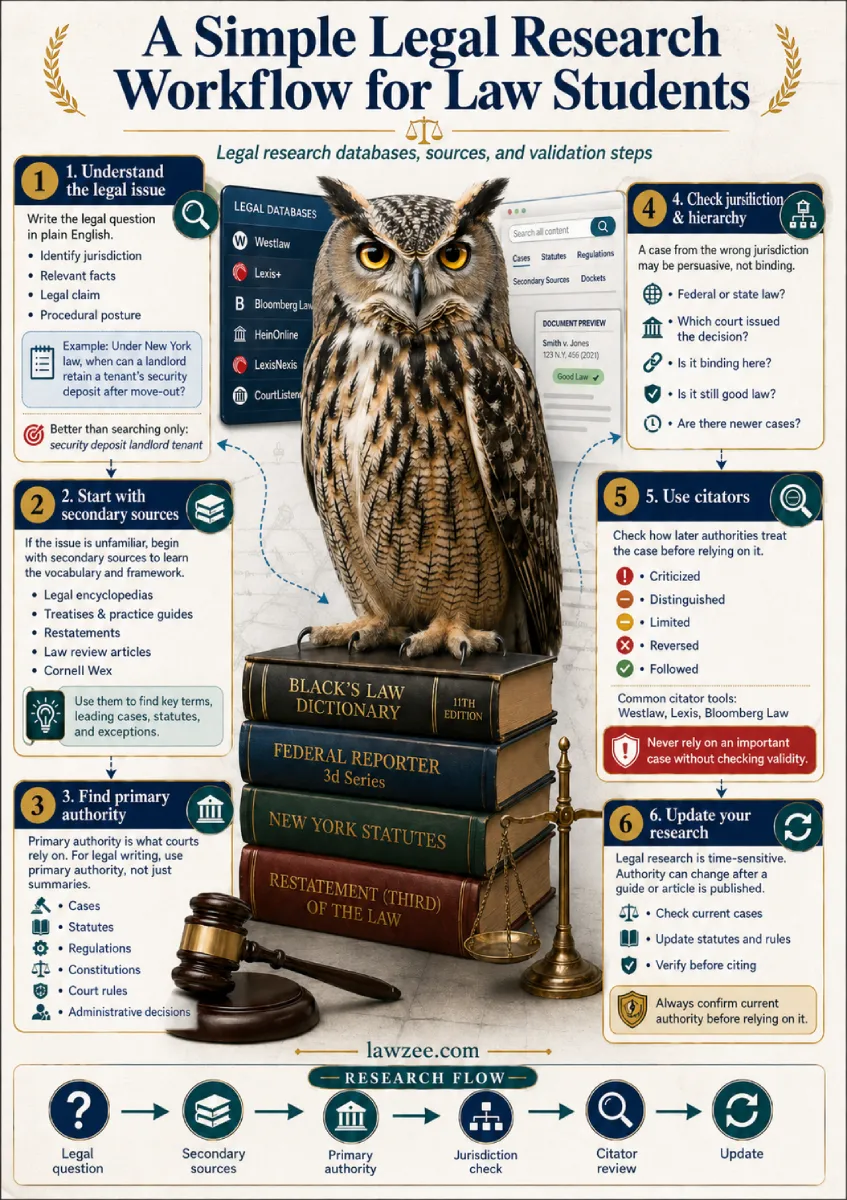
A Simple Legal Research Workflow for Law Students

Six-step legal research workflow for law students
1

Understand the legal issue

Write the legal question in plain English before searching. Identify the jurisdiction, facts, claim, and procedural posture.

Under New York law, when can a landlord retain a tenant's security deposit after move-out?

2

Start with secondary sources

Use legal encyclopedias, treatises, practice guides, restatements, law review articles, or Cornell Wex when the issue is unfamiliar.

3

Find primary authority

Primary authority includes cases, statutes, regulations, constitutions, court rules, and administrative decisions.

4

Check jurisdiction and hierarchy

Ask whether the authority is federal or state, binding or persuasive, current or outdated, and issued by the right court.

5

Use citators

Use KeyCite, Shepard's, or another citator to check whether a case has been criticized, distinguished, limited, reversed, or followed.

6

Update your research

Legal research is time-sensitive. Always check for current authority before relying on a case, statute, rule, or guide.

Common Mistakes Law Students Make

Starting with broad keyword searches

Broad searches often produce too many irrelevant results. Start with a research question, jurisdiction, and key legal concepts.

Ignoring secondary sources

Secondary sources can save time by pointing you to leading cases, statutes, elements, defenses, and exceptions.

Forgetting jurisdiction

A case may sound helpful but be irrelevant if it comes from the wrong jurisdiction or court level.

Relying on outdated law

Always check whether cases and statutes are current before citing them.

Treating AI-generated summaries as authority

AI tools can help brainstorm search terms or summarize concepts, but they should not replace primary legal authority or independent verification.

Legal Research Database Frequently Asked Questions

Q:What is the best legal research database for law students?

The best database depends on the task. Westlaw and Lexis are commonly used for case law, statutes, and citator research. Bloomberg Law is strong for dockets, legal news, and practice-oriented research. HeinOnline is excellent for law reviews and historical materials. Free tools like Google Scholar, CourtListener, Cornell LII, and Justia are helpful starting points.

Q:Is Google Scholar good for legal research?

Google Scholar is useful for finding free case law and scholarly materials. However, it is not a complete substitute for Westlaw, Lexis, or Bloomberg Law because it lacks many professional legal research features, including advanced citator tools and editorial research aids.

Q:Is HeinOnline good for case law?

HeinOnline is best known for law journals, legal scholarship, historical materials, and specialized legal collections. For current case law research, students usually use Westlaw, Lexis, Bloomberg Law, CourtListener, Justia, or Google Scholar.

Q:What database should I use for law review research?

HeinOnline is one of the strongest tools for law review research. Westlaw, Lexis, Bloomberg Law, and Google Scholar can also help locate law review articles.

Q:What is the best free legal research database?

There is no single best free tool for every task. Google Scholar is useful for broad searching, CourtListener is strong for free case law and federal materials, Cornell LII is helpful for legal definitions and federal law, and Justia provides free legal information, cases, codes, and regulations.

Q:Do law students get free access to Westlaw, Lexis, and Bloomberg Law?

Many law schools provide students with access to Westlaw, Lexis, Bloomberg Law, and other databases. Access depends on the school, licensing terms, and student status.

Final Thoughts

Legal research is less about memorizing databases and more about building a repeatable process. Start with the legal issue, use secondary sources to understand the area, find primary authority, check jurisdiction, verify that the law is still current, and keep track of your sources.

For law students, the strongest approach is to learn both paid and free tools. Paid platforms like Westlaw, Lexis, Bloomberg Law, and HeinOnline provide powerful research features, while free tools like Google Scholar, CourtListener, Cornell LII, and Justia can help you research efficiently when subscription access is limited.

Related Lawzee Resources

Law School Admissions CalculatorLaw School RankingsLSAT Prep ResourcesBest Law Schools by StateLaw School Comparison ToolBar Exam Prep ResourcesLaw School Application Timeline

Tags

Legal ResearchWestlawLexisBloomberg LawHeinOnlineDatabases